Spanish Florida
Prior to its annexation by the United States, Florida was a colony of Spain. From the founding of St. Augustine in 1565 to the collapse of their empire in the 1820s, the Spanish built forts, missions, and attempted to settle the subtropical, humid peninsula despite competition from other European powers.
Understand
The history of Spanish colonial interests in Florida can be separated into two distinct periods: 1513-1763 and 1783-1821. During the first Spanish period, Florida was one territory ruled through the Captaincy General of Cuba, while during the second Spansh period, it was divided into West and East Florida with capitals in Pensacola and St. Augustine respectively.
The first European explorer of Florida was Ponce de León. Various sites in the state have been named after him, such as DeLeon Springs, Ponce Inlet, and the Ponce de León Fountain of Youth in St. Augustine. However, despite his and others' explorations across the Southeastern U.S., the Spanish took little interest in the region due to its small Native population and lack of natural resources. Spanish settlement did not begin in earnest until 1565, when Admiral Pedro Menéndez de Avilés founded the colony of St. Augustine on the Florida Peninsula's eastern coast. The admiral and his settlers established Mission Nombre de Dios and, subsequently, missions throughout what is now Florida, Georgia, and South Carolina. However, apart from Nombre de Dios, these missions were established as temporary structures. Once the British began colonizing Georgia and South Carolina in earnest, the Spanish abandoned their northernmost missions and they vanished entirely. The original capital of Spanish Florida, Santa Elena near modern Beaufort, South Carolina, was abandoned in the late 16th century and nothing remains of the site above ground.
.jpg)
Spanish efforts in today's state of Florida, though, were more successful. In the 17th century, the Spanish established a second colony in Pensacola and built a fort — Castillo de San Marcos — in St. Augustine. This came at a cost, as the Spanish used their remaining missions between the two colonies to recruit indigenous tribes for labor. Contact with these tribes led to their eradication by infectious diseases. Seminoles moved in from the north and settled Florida in their place, becoming the dominant population of Florida outside of Spanish settlements and runaway African slaves. By the 18th century, the decline of the Spanish Empire, combined with failed attempts at settlement and war against the British, led Spain to neglect Florida. In 1763, Spain handed over Florida to Britain in a peace treaty that concluded the Seven Years' War. The British divided Spanish Florida into two colonies, West and East Florida, but did little with these colonies during their twenty years in control.
After the American War of Independence, the British returned Florida to Spain. The Spanish maintained the division of the two colonies, but this time they took a more active role in settlement. Realizing the Americans had their eyes on the region, the Spanish aimed to establish clear control. They built the St. Augustine Basilica, founded Fernandina Beach, and presided over rapid population growth in the previously underpopulated Pensacola. Their fortunes were short-lived, though, as American General Andrew Jackson used the pretext of the Seminoles to lead incursions into Florida. With the Napoleonic Wars in Europe and wars for independence taking root across Latin America, the Spanish handed over both its Florida colonies to the United States and focused on holding onto its crumbling empire.
Although most of Spain's rural missions were lost to history, the Spanish district of St. Augustine was preserved. A few other sites survived in part, including a couple of houses built in Pensacola during the second Spanish period and some underwater shipwrecks off the coast. Museums in St. Augustine and the McLarty Treasure Museum farther south contain artifacts of Spanish colonization. In the late 20th and early 21st centuries, historians began reconstructing Spanish colonial sites in Florida. Examples include Gracia Real de Santa Teresa de Mose (Fort Mose) and Mission San Luis in Tallahassee.
Destinations
Historic sites
- 🌍 Castillo de San Marcos, 1 S Castillo Dr, St. Augustine, ☏ +1 904 829-6506. The fort was built by the Spanish in the late 17th century to protect their colony in St. Augustine. Although it has transferred hands several times (most notably under the British and later, Americans), it has never been taken in battle. It's well-preserved and open to the public as a historic site.

.svg.png)
- 🌍 Cathedral Basilica of St. Augustine, 38 Cathedral Pl, St. Augustine, cathparish@gmail.com. This church was built in the 1790s during the second Spanish period. In 1870, it was upgraded to a cathedral, but suffered damage from a fire in 1887. Its construction out of coquina stone enabled its survival. The bell tower was built during renovations following the fire and houses four bells, one of them coming from a much earlier Spanish church and dating back to 1682. In 1976, it was upgraded to a minor basilica and continues to function as the seat of the Catholic Bishop of St. Augustine.
- 🌍 Fort Caroline, 12713 Fort Caroline Rd, Jacksonville, ☏ +1 904 641-7155. A French colony that was founded in the 1560s but was defeated by the Spanish. The fort is a recontruction of the original French one and is a part of Timucuan Ecological & Historic Preserve, which is run by the National Park Service.
- 🌍 Fort George (Fort San Miguel), 501 N Palafox St, Pensacola (North Hill Preservation District), ☏ +1 850 436-5670, TVaden@cityofpensacola.com. The fort was built by the British in 1778 and captured by the Spanish in 1781 during the Siege of Pensacola. It has been partially rebuilt, as the original did not survive, at its original site at Fort George Memorial Park.
.jpg)
- 🌍 Fort Matanzas, 8635 FL-A1A South, St. Augustine, ☏ +1 904 471-0116. In response to James Oglethorpe's 1740 British raid on Spanish Florida, the Spanish built Fort Matanzas in 1742 and protected the southern approach to St. Augustine via the Matanzas River. The fort was built from coquina, so despite being abandoned after Florida was handed to the British in 1763, the fort structure survived until the early 20th century, when restoration work was carried out. It was developed into a national monument for tourists in the 1930s, and in 2008 even the 20th century visitor center became recognized by the U.S. as a historic site.
- 🌍 Fort Mose (Gracia Real de Santa Teresa de Mose), 15 Fort Mose Tr, St. Augustine, ☏ +1 904 823-2232. 9AM-5PM. The original fort and surrounding settlement was built by runaway African slaves in 1738 with support of the Spanish government in St. Augustine. A second fort was built in 1752 but collapsed after Spain lost control of the area to Britain. In 2025, a replica of the fort was built, as the original structures including the settlement were destroyed by successive sieges by the British and Native tribes. Free.
- 🌍 Fountain of Youth, 11 Magnolia Ave, St. Augustine, ☏ +1 904 829-3168. 9AM-6PM. The park has long been rumored (without evidence) to be where Ponce de Leon landed in 1513. It was added to the National Register of Historic Places in 2016. The park is privately owned.
- 🌍 González-Álvarez House, 14 St. Francis St, St. Augustine, ☏ +1 904 824-2872, magen@sahs1883.com. 10AM-5PM. The house is one of the oldest (if not the oldest) house in St. Augustine, dating to 1723 during the first Spanish period. Its architectural style, using coquina and tabby concrete, was chosen to provide insulation from hot summer weather. Since 1918, the house has been owned by the St. Augustine Historical Society.
- 🌍 Julee Cottage, 210 E Zaragoza St, Pensacola. The house was built in the early 1800s, during the second Spanish period. It is one of the few surviving wood houses from the era. It was originally owned by a free woman of color, Julee Panton, but was later moved into the living history museum of Pensacola for preservation purposes. The inside has been decorated with furniture from the 19th century.
- 🌍 Kingsley Plantation.
- 🌍 Lavalle House, 203 E Church St, Pensacola. This French Creole house was built during the early 19th century (second Spanish period) by Charles Lavalle. It has since been moved to Pensacola's living history museum and added to the National Register of Historic Places.
- 🌍 Mission Nombre de Dios.
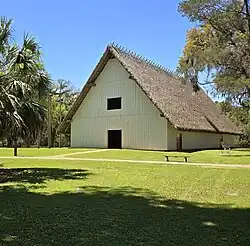
- 🌍 Mission San Luis de Apalachee, 2021 Mission Rd, Tallahassee, ☏ +1 850 245-6406, info@missionsanluis.org. This Spanish mission was built in 1656 in the town of Anhaica, the Apalachee predecessor of the city of Tallahassee. It was destroyed by the Spanish in 1704 due to the Creek invasions that preceded the arrival of the Seminoles in the region. In the late 20th and early 21st centuries, historians facilitated the rebuilding of the site based on archaeological and historical evidence. A fort and Franciscan church have been built at the site.
- 🌍 Mission Santa Catalina de Guale, St. Catherine's Island, Georgia. A 17th-century Spanish mission that was excavated during the 1990s following its rediscovery. Little remains above ground, but Spanish artifacts have been found at the site and palm trees have been planted to outline the original structure of the church. Foundations at the complex are at risk of erosion into a nearby estuary. Public access is hence restricted to historical research and church services which are held on occasion.
- 🌍 O'Reilly House, 32 Aviles St, St. Augustine, OReillyHouseFL@ssjfl.org. Tu-Su 10AM-4PM. The house was likely built during the 1600s. It was renovated in the late 18th century by Father Miguel O'Reilly, who willed the house to nuns. Since 1866, it has been run by the Sisters of St. Joseph of St. Augustine. Free (with donations).
- 🌍 Old Town Fernandina, Estrada St, Fernandina Beach. The last town to be built in the Americas according to the Laws of the Indies, which governed Spanish settlement from the 16th century onward. Hence, a historic plaza remains along with the street grid south of Fort Clinch. However, Spain lost control of the town before it could grow into a major settlement, and the buildings that now exist were built after annexation by the United States. A plaque marks the past location of a fort in the central plaza.
- 🌍 Peña-Peck House, 143 St. George St, St. Augustine, ☏ +1 904 829-5064, info@penapeckhouse.com. W-Sa noon-4 PM. The house dates back to the 18th century during the first Spanish period. Privately owned by the Woman's Exchange of St. Augustine, the house contains a gift shop and provides audio tours.
- 🌍 St. Francis Barracks, Marine St, St. Augustine. The barracks were built in the mid-18th century during the first Spanish period but were occupied by friars until the British converted them for military use. They continue to be used, now by the U.S. National Guard, as a military installation and are not open to the general public, although they can be seen from the surrounding streets.
- 🌍 San Marcos de Apalache Historic State Park.
- 🌍 San Pedro Underwater Archaeological Preserve State Park.
- 🌍 Ximenez-Fatio House.
Museums
- 🌍 McLarty Treasure Museum (Survivors' and Salvagers' Camp), 13180 N FL-A1A, Vero Beach. Documents the story and treasure of the 1715 Spanish shipwreck that occurred close to the museum site. There are a number of artifacts kept in the museum including porcelain dinnerware and precious metals.
- 🌍 Pensacola Museum of History.
- 🌍 Spanish Military Hospital Museum, 3 Aviles St, St. Augustine, ☏ +1 904 342-7730. 9AM-5PM. A guided tour through the museum describes the medical practices used on Spanish soldiers during the time period. At this time, most of the procedures performed were amputations. There is also an exhibit with examples of medicines and remedies from the time period.
- 🌍 University of West Florida Archaeology Institute Museum.
Go next
See also
- El Camino Real — a route connecting 21 Spanish missions across California
- Gringo Trail — places commonly visited by Americans outside of the U.S., many of them in Latin America
- Seminole Wars — a war fought during and after Spanish colonization in Florida between the United States and the Seminoles